
Roster governance: see, decide, prove.
A command dashboard across every roster in the organization: KPIs on essential levels of care (LEA), staffing coverage and costs, compliance approval, escalation from the wards — and for healthcare groups, a single dashboard across all sites.
ALISEO ES gives Healthcare Management a command dashboard across every roster in the organization: aggregated KPIs on levels of care (LEA), staffing coverage and costs, compliance approval, monitoring by rostering group and audit-ready reports. Governance is multi-level (operational, intermediate, executive) with RBAC permissions and a cell-by-cell audit trail; escalation brings to Management only what requires a decision. Clinic groups govern all their sites from a centralized dashboard.
Last updated: 5 July 2026
The command dashboard
Every roster, at a glance
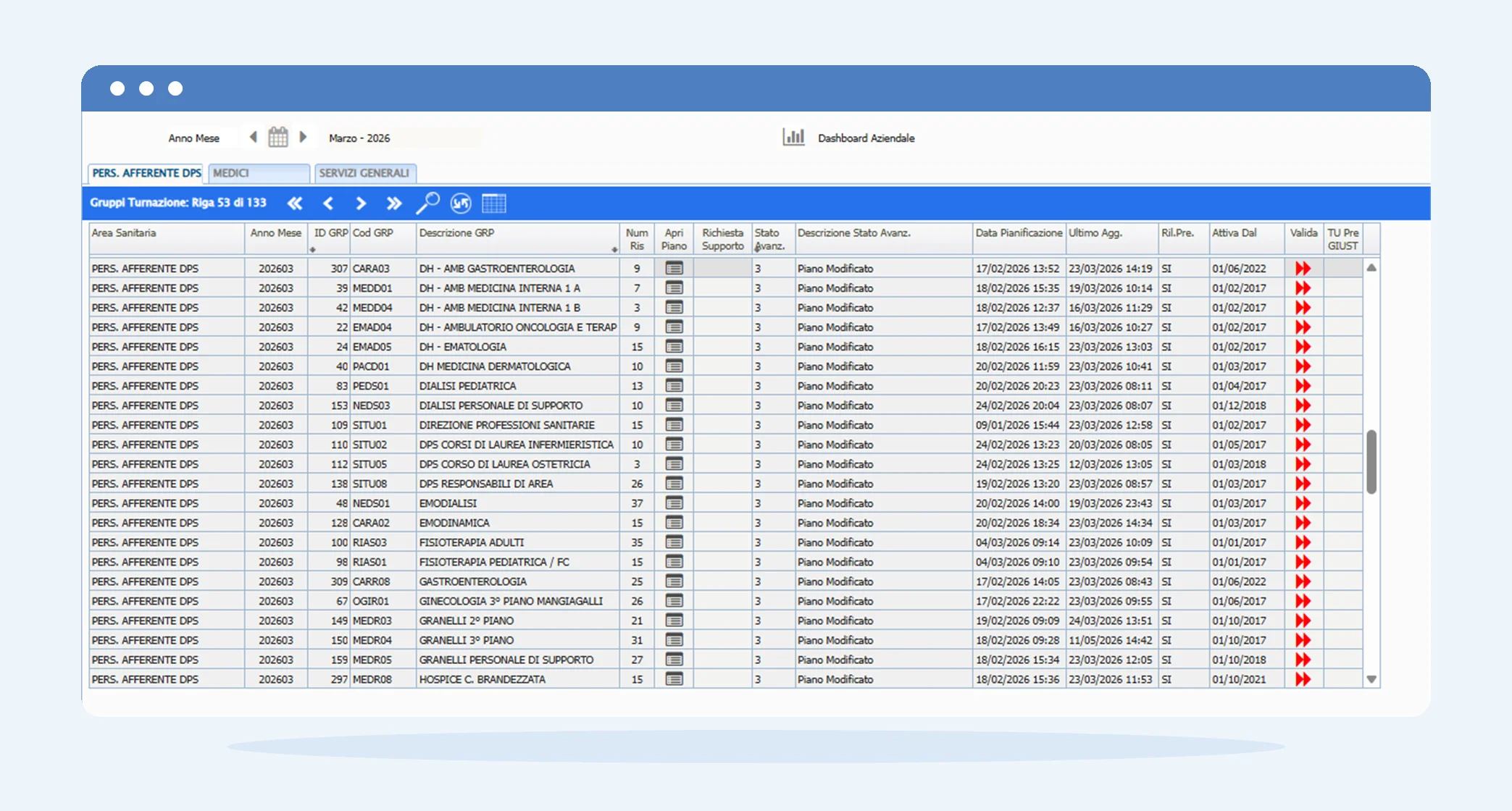
Monitoring by rostering group shows the status of every roster in the organization: in draft, ready for validation, validated, modified. Understaffed wards stand out on their own.
The compliance approval
Management grants its approval on the verified roster; if it is changed during validation, the roster automatically rolls back to its previous status: no silent changes, ever.
KPIs that speak your language
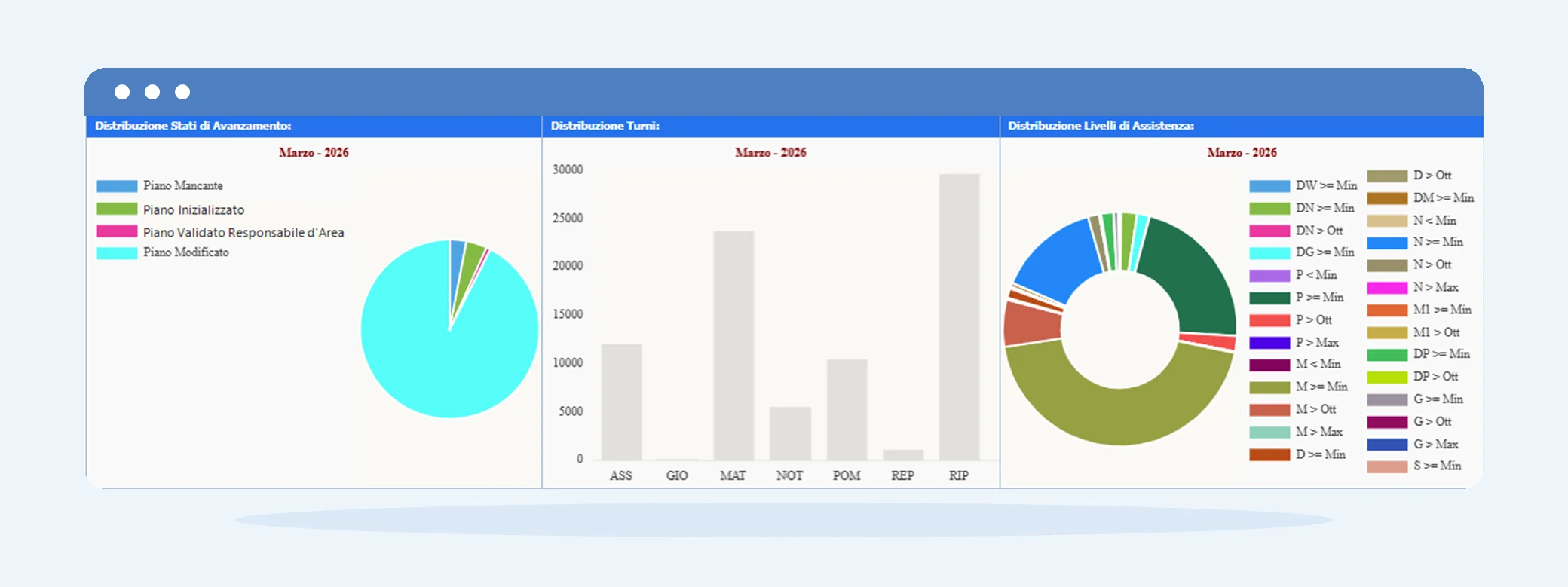
Levels of care (LEA), coverage by role, costs: budgeted vs actual, overtime vs budget, contractual deadlines. Aggregated by ward, department, organization.
Audit-ready evidence
Every cell of the roster board is historicized: user, date and time, previous value. Audit extractions are a single operation, not a reconstruction.
The LEA, measured even daily
This page’s claim: the roster becomes a clinical indicator. ALISEO ES calculates — even daily — the minutes of care per bed from admission data (ADT) and compares them with the minimums guaranteed by regional and national LEA. When the minutes stay below threshold for several days, the Medical Direction receives the evidence and intervenes immediately — before an organizational situation becomes a clinical problem.
No other rostering tool in Italy offers Management this control.
Where the data comes from: Interoperability (ADT, attendance, personnel records) →
Escalation: only what matters reaches Management
Problems get solved at the right level. The planner rosters and handles the exceptions; what they cannot solve — structural shortages, unavoidable violations, conflicts between wards — escalates to Management, with the context already documented. Multi-level governance (operational, intermediate, executive) with RBAC visibility ensures everyone sees what they need, and signs off on what is theirs to decide.
Reporting: two altitudes, one truth
Operational (for those who manage) — Staff situation, understaffed wards, reallocatable staff: the answers to decide today.
Executive (for those who govern) — Roster monitoring by rostering group, budgeted/actual, fire-safety and BLS-D coverage, LEA, anomalies, overtime vs budget, contractual deadlines: the evidence to decide the month and the year.
Same data source, no reconciliation: the number Management sees is the same one the ward sees.
HR policies are enforced on the roster board
Company policies on leave, time-off allowances and overtime don’t stay in circulars: they are applied while rostering. The planner has the attendance/absence record counters directly on the roster board and acts immediately on the budget levers — reducing accrued leave balances, managing time-off allowances, monitoring overtime against the budget. ALISEO ES also supports leave planning.
And there is a multiplier Healthcare Management knows well: nurses are the majority of the workforce — even a small rostering intervention produces a large cumulative effect on the budget.
Clinic groups: one control room
Healthcare groups with multiple sites have a centralized dashboard on each clinic’s rostering: roster progress, adherence to group HR policies, consistent comparison across sites. Group governance stops depending on reports built by hand at each site.
The impacts that matter
- Preventive compliance — violations are blocked upstream, exceptions stay tracked.
- Cost control — accrued leave and time-off allowances governed through the attendance-record counters, overtime monitored against budget, less reliance on agency staff thanks to reallocations and cooperation between wards. On the majority of the workforce, every intervention has a cumulative effect.
- Quality of care — LEA under control, coverage guaranteed by role.
- Staff who stay — fair, transparent rosters (on-call shifts (guardie), nights and standby availability distributed evenly): fairness is a retention lever, and it shows in the counters.
- Accountability — who decided what, when and why: always reconstructable.
Frequently asked questions
What does Healthcare Management see in ALISEO ES?
A command dashboard across every roster in the organization: the status of each roster by rostering group, KPIs on LEA, staffing coverage and costs, anomalies and escalations from the wards, with audit-ready extractions.
How does the compliance approval work?
Management grants its approval on the roster verified by the pre-validation checks. If the roster is modified during validation, it automatically rolls back to its previous status and every change stays tracked cell by cell.
How does Management monitor the LEA?
ALISEO ES calculates, even daily, the minutes of care per bed from ADT data and compares them with the LEA minimums: if the minutes stay below threshold for several days, Management receives the evidence and can intervene immediately.
Is ALISEO ES suitable for groups with multiple sites?
Yes: clinic groups have a centralized dashboard on each site’s rostering, to monitor roster progress and adherence to group HR policies consistently across all sites.
How does it help control staff costs and enforce HR policies?
During rostering, the attendance/absence record counters make it possible to act immediately on the budget levers: reducing accrued leave balances, managing time-off allowances, monitoring overtime against budget — and the system also supports leave planning. Since nurses are the majority of the workforce, even small interventions have a large cumulative effect.
Further reading from the blog
Physician rostering: by activity, not by category
Physicians’ rosters are not planned like those of nursing and support staff: activities, on-call shifts and standby availability, fairness. How to manage them in a single system.
Can a generative AI build the ward roster?
A generative AI produces a plausible roster, but it does not guarantee rest periods and coverage: why rostering requires an optimization engine.
Want to see the executive dashboard on your organization’s rosters?
Pick the date and time of your demo, or write to us directly.
Book a demo